





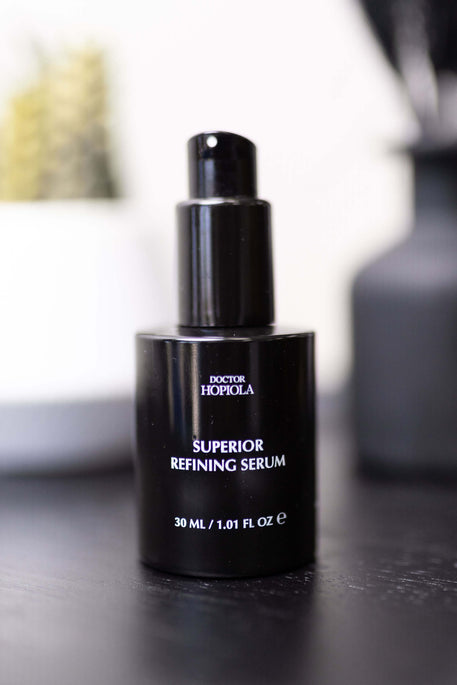
Dr. Hopiola Chronicles: Vol. 2: Protocol Architecture: The Physics Behind Our “Inverse-Phase” Layering
Why We Apply Oil Before Serum: Through the Lens of Emulsion Science
Most people learn the “thinnest-to-thickest” skincare rule. It’s useful, but it doesn’t reflect the actual physics of how different systems interact on the skin surface. When we look at formulation science, particularly miscibility and continuous-phase behavior, the order of application can shift.
Our two-step ritual uses an anhydrous oil followed by a water-in-oil (W/O) serum. This appears unconventional, but the science behind it is straightforward when you understand how lipid-continuous systems behave.
Step 1: The Anhydrous Oil: Preparing the Skin Surface
An anhydrous oil has low surface tension and spreads easily, creating a smooth, even layer across the skin.
Cosmetically, this first step:
-
helps soften the appearance of dryness
-
enhances spreadability for the second step
-
creates a uniform lipid layer that pairs well with oil-continuous emulsions
This is an architectural choice that improves how subsequent layers interact.
Step 2: The Water-in-Oil Serum: The “Inverse-Phase” Layer
Most serums are Oil-in-Water (O/W), meaning water is the continuous phase. O/W products tend to evaporate quickly and do not layer well over oils.
Our serum is Water-in-Oil (W/O) - the continuous phase is lipid.
Why this matters:
-
Miscibility: The outer lipid phase of the W/O serum blends seamlessly with the oil from Step 1.
-
No slippage: Because both layers are lipid-continuous, they merge rather than repel.
-
Cosmetic benefit: The merged layers create a smooth, cohesive finish on the skin.
Inside the emulsion, the water droplets are held within the lipid structure, supporting a hydrated, supple appearance over time.
The “Lipid-Continuous” Protocol: A Cosmetic Perspective
This protocol emphasizes continuity:
-
Step 1: Lightweight oil → smooth, flexible base
-
Step 2: W/O serum → longer-lasting, more substantive finish
Together, they create a layered effect that supports:
-
a more moisturized look
-
improved glide and texture
-
a comfortable, cushioned skin feel
This formulation strategy is about designing the experience of application and the way the skin’s surface appears and feels afterward.
So, when we are asked why the serum goes last: our simplified response is this -
-
Most serums are water-based → they must go before oils.
-
Our serum is oil-continuous (W/O) → chemically behaves more like a rich balm, so it goes after the oil.
It’s all about phase behavior.
This article is part of the Dr. Hopiola Chronicles, a series where I break down the science behind ingredients and formulation decision. No hype, just thoughtful education.


