





How to Start a Natural Skincare Routine
By Dr. Hope Ijaola, Board-Certified Internist and Founder of Doctor Hopiola
If you have been thinking about starting a natural skincare routine and have no idea where to begin, you are in good company. The skincare aisle is overwhelming. Social media makes every product feel essential. Influencers recommend ten-step routines. Friends suggest entirely different ten-step routines. By the time you finish researching, you may feel less informed than when you started.
As a physician, I want to offer something simpler. The truth is that you do not need ten products. You do not need to memorize every active ingredient on the market. What you need is an understanding of what your skin actually does, what it actually needs, and a small number of well-chosen products that meet those needs consistently.
This is a beginner's guide to starting a natural skincare routine, written from the perspective of a physician and the founder of a brand built around the principle that simpler routines often produce better outcomes than complicated ones.
Doctor Hopiola is a physician-formulated skincare brand focused on simplified, barrier-supportive routines designed for beginner skin.
What Does "Natural Skincare" Actually Mean?
"Natural skincare" is a phrase that gets used in many different ways. In general, the term natural skincare is often used to describe products formulated primarily with plant-derived ingredients, with an emphasis on avoiding synthetic fragrances, harsh surfactants, and ingredients that have been associated with skin irritation or environmental concerns.
A few things are worth knowing as you begin:
-
"Natural" does not automatically mean better. Some natural ingredients are highly irritating, and some synthetic ingredients are very well tolerated. Quality of formulation matters more than the natural-versus-synthetic label.
-
Plant-based does not mean ineffective. Many plant-derived ingredients are well-studied and have meaningful research supporting their benefits.
-
"Clean" and "natural" are marketing terms. They overlap but are not identical, and neither is regulated.
A thoughtful natural skincare routine is one that uses well-formulated, plant-based products and avoids the most common irritants, while choosing ingredients with real evidence behind them.
Start with What Your Skin Actually Does
Before thinking about products, it helps to understand the basics of how your skin works.
Your skin is a living, functioning organ. Its outermost layer, called the stratum corneum, is your skin barrier. The barrier is made of skin cells held together by a matrix of lipids, like a brick wall held together with mortar. When the barrier is healthy, it does several important things at once: it keeps moisture in your skin, keeps irritants out, and helps your skin look comfortable, smooth, and bright.
Many common skincare concerns are influenced by barrier health. Dryness, sensitivity, redness, breakouts, dullness. These are often signs that the barrier is under stress. The good news is that supporting the barrier is one of the most important foundations for any skincare routine, and it is also the simplest.
Natural Skincare Ingredients That Work
When you are starting out, knowing which ingredients to look for makes the rest easier.
Plant-Based Lipids
Plant-derived oils like jojoba, rosehip, and sunflower seed oil have been studied for their ability to support skin barrier function through their fatty acid composition and anti-inflammatory properties.¹ A well-formulated facial oil can be one of the most foundational products in a natural routine, especially for skin that feels dry, depleted, or reactive.
Bakuchiol
Bakuchiol is a plant-derived ingredient that has been studied as a gentler alternative to retinol. A randomized, double-blind clinical study published in the British Journal of Dermatology found that bakuchiol demonstrated similar improvements in the appearance of fine lines and pigmentation in one clinical study compared to retinol, with less reported irritation and scaling.² For people who want visible results with less reported irritation than traditional retinoids, bakuchiol is worth knowing about.
Niacinamide
Niacinamide, a form of vitamin B3, is widely studied and well-tolerated by most skin types. It is a versatile, gentle ingredient that often appears in formulations for sensitive or beginner skin.
Hyaluronic Acid and Glycerin
Both are humectants, meaning they help your skin hold onto water. They are well-tolerated and helpful in supporting hydration.
Antioxidant-Rich Plant Extracts
Plant extracts with antioxidant properties can help defend skin against environmental stressors. These ingredients tend to be gentler than high-concentration synthetic actives and are a good fit for a beginner routine.
Ingredients to Approach With Caution as a Beginner
When you are just starting out, certain ingredients are worth approaching carefully or avoiding altogether until you know how your skin responds to gentler products first.
-
Synthetic fragrance, which is one of the most common causes of skin irritation
-
Denatured alcohol, which can disrupt the skin barrier
-
High concentrations of exfoliating acids, which can over-strip skin that has not yet built tolerance
-
Strong retinoids at high concentrations, which can cause significant irritation in beginner routines if introduced too aggressively
-
Multiple actives layered together, which is one of the most common reasons beginner routines backfire
A good rule of thumb when starting out: introduce one new product at a time, give your skin two to four weeks to adjust, and watch for signs of irritation before adding anything else.
How Many Products Do You Actually Need?
Far fewer than the internet would have you believe. As a physician, I see the consequences of over-routining all the time. Patients arrive with skin that is reactive, inflamed, and worse than when they started, often after layering multiple actives, exfoliants, and serums in an attempt to address every concern at once.
A genuinely effective beginner routine can be built around a handful of products that do specific jobs:
-
A gentle cleanser to remove impurities without disrupting the skin barrier
-
A nourishing facial oil to help support barrier function and reduce moisture loss
-
A refining serum to support the appearance of smoother texture and more even-looking skin
-
A broad-spectrum sunscreen for daily protection against UV damage
That is it. Four products. You can absolutely build from here over time, but you do not need to start with more than this.
A Simple Natural Skincare Routine for Beginners
Morning
-
Cleanse gently using lukewarm water and a fragrance-free, non-stripping cleanser
-
Press a few drops of facial oil into clean, slightly damp skin
-
Follow with a refining serum, smoothing it over your face and neck
-
Apply broad-spectrum mineral sunscreen as your final step
Evening
-
Cleanse to remove the day
-
Apply your facial oil
-
Apply your serum
That is the whole routine. Morning and night. Consistency is the most important factor. Skin responds to steady, gentle care over weeks and months, not to intensity or constant change.
How Doctor Hopiola Fits into a Beginner Routine
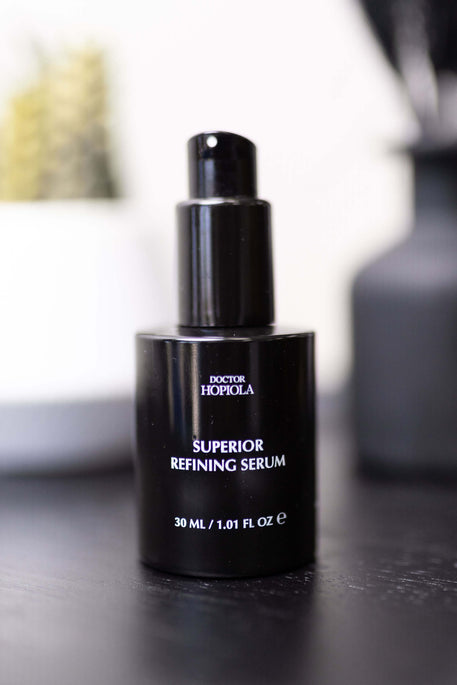
Doctor Hopiola is a skincare brand built around a two-step practice. The Brilliance Oil Concentrate is a plant-based facial oil designed to be applied first to clean, slightly damp skin. It is formulated to support the skin barrier and improve the appearance of dry, depleted skin. The Superior Refining Serum follows and is formulated with bakuchiol and botanical extracts to help reveal skin that looks calmer and more radiant.
For someone starting a natural skincare routine, the Radiance Set is intentionally simple. It replaces the middle of a complicated routine with two products that are designed to support the skin barrier and improve the appearance of tone and texture without overwhelming the skin. You can layer it with the cleanser and sunscreen you already trust, which means starting a natural routine does not require replacing your entire bathroom counter.
As with any new skincare product, a patch test is recommended, and individual results may vary.
How Long Before You See Results?
Skin responds gradually to consistent care. Most people begin to notice softer texture and a more comfortable feel within two to four weeks. More noticeable changes with healthier-looking, more resilient skin often become visible around the eight to twelve week mark.
The most common beginner mistake is judging a routine too quickly and switching products before they have had a chance to work. Give your skin time. Resist the urge to add more.
Frequently Asked Questions
How do I start a natural skincare routine if I have never had one?
Start small. A gentle cleanser, a nourishing facial oil, a refining serum, and a broad-spectrum sunscreen are enough to build a complete beginner routine. Use the same products consistently morning and night for at least four weeks before adding anything new. Watch how your skin responds, and let the routine prove itself before you expand it.
Are natural skincare products effective?
When they are well-formulated, yes. Many plant-derived ingredients have meaningful research behind them, including plant-based oils for barrier support¹ and bakuchiol as a gentler alternative to retinol.² The key is choosing products built around evidence-supported ingredients rather than just products marketed as "natural."
What ingredients should I avoid in natural skincare?
As a beginner, it is worth approaching synthetic fragrance, denatured alcohol, high concentrations of exfoliating acids, and multiple actives layered together with caution. These are common sources of irritation, especially for skin that is just starting to build a routine.
Do I really need only four products?
To start, yes. A gentle cleanser, a facial oil, a refining serum, and a sunscreen cover the foundational work that most skin needs. You can add to this over time as you learn how your skin responds, but more products are not automatically better. In many cases, fewer products produce better results. Daily sunscreen remains the single most important step for long-term skin health and prevention of visible photodamage.
How long should I use a new skincare routine before judging the results?
Give it at least four weeks of consistent use, ideally eight to twelve weeks for visible changes in tone and texture. Skin responds gradually. The most common reason new routines fail is that people abandon them before the routine has had time to work.
What is Doctor Hopiola?
Doctor Hopiola is a cosmetic skincare brand built around a two-step, oil-first routine. The Brilliance Oil Concentrate and Superior Refining Serum are formulated with plant-based ingredients designed to support the skin barrier and improve the appearance of tone, texture, and overall skin health. Founded by Dr. Hope Ijaola, a board-certified internist, the brand is built around the belief that thoughtful, simple routines produce better outcomes than complicated ones.
A Simpler Approach to Natural Skincare
Starting a natural skincare routine does not have to be complicated, expensive, or overwhelming. The most useful thing you can do is choose a small number of well-formulated products and use them consistently. Skin responds to consistency more than it responds to intensity, and the simpler your starting point, the easier it is to learn what your skin actually needs.
Doctor Hopiola was built with this philosophy in mind: a simplified, intentional approach to skincare designed to support skin barrier function, hydration, and the appearance of healthy, radiant skin.
This content is for educational purposes only and does not constitute medical advice.
Doctor Hopiola products are cosmetic formulations and are not intended to diagnose, treat, cure, or prevent any disease.
Individual results may vary.
References
1. Lin TK, Zhong L, Santiago JL. Anti-Inflammatory and Skin Barrier Repair Effects of Topical Application of Some Plant Oils. International Journal of Molecular Sciences. 2018;19(1):70.
2. Dhaliwal S, Rybak I, Ellis SR, et al. Prospective, randomized, double-blind assessment of topical bakuchiol and retinol for facial photoaging. British Journal of Dermatology. 2019;180(2):289-296.


