





Bakuchiol: A Gentler, Plant-Derived Alternative to Retinol
If retinol has ever left your skin red, flaky, or too uncomfortable to continue, you are not alone.
Retinol remains one of the most extensively studied cosmetic ingredients for the visible signs of photoaging. It can also be difficult to tolerate.
Bakuchiol offers a different path. It is plant-derived, it is not a retinoid, and early research suggests it may help improve the appearance of fine lines and uneven pigmentation with less reported irritation.
That promise is meaningful. So are the limits of the evidence.
Here is what we know.
What Bakuchiol Is
Bakuchiol is a naturally occurring compound found in the seeds and leaves of Psoralea corylifolia, also known as the babchi or bakuchi plant.
You may see bakuchiol described as "natural retinol." The phrase is easy to understand, but it is not scientifically accurate.
Retinol is a form of vitamin A. Bakuchiol is an entirely different molecule. It does not become retinoic acid in the skin, and it is not a botanical form of retinol.
The comparison comes from laboratory research showing that bakuchiol and retinol influence some overlapping patterns of gene expression, as well as early clinical research evaluating similar visible concerns.¹
In other words, bakuchiol may support some of the cosmetic benefits people seek from retinol. It does so through a different path.
What the Research Shows
Bakuchiol has been studied more seriously than many botanical skincare ingredients, but its evidence base remains much smaller than that of retinoids.
A 2014 paper compared the activity of bakuchiol and retinol in laboratory models and reported similarities in several measures associated with skin renewal and the extracellular matrix. The paper also included clinical testing in which a bakuchiol formulation was associated with visible improvement after 12 weeks of twice-daily use.¹
It was an important beginning. It was not a large, independent randomized trial.
The most frequently cited direct comparison followed in 2019.
In that 12-week, randomized, double-blind study, 44 participants used either a cream containing 0.5% bakuchiol twice daily or a cream containing 0.5% retinol once daily. Both groups showed statistically significant improvements in wrinkle surface area and hyperpigmentation, with no statistically significant difference between the groups. Participants using retinol reported more scaling and stinging.²
That finding is encouraging, particularly for people who struggle to use retinol consistently.
It does not prove that bakuchiol and retinol are interchangeable.
The study was small. It lasted 12 weeks. The two products were used at different frequencies, and there was no vehicle-only comparison group. The results also apply to the specific formulations studied—not automatically to every product containing bakuchiol.
A 2022 systematic review found the existing evidence promising while emphasizing the need for larger, more rigorous clinical studies.³
The responsible conclusion
Bakuchiol is a promising, generally well-tolerated cosmetic ingredient for the visible signs of photoaging.
Retinoids have a considerably larger body of evidence behind them. Bakuchiol does not need to be called retinol, or treated as its equal, to be a thoughtful option in its own right.
Is Bakuchiol Gentler Than Retinol?
For many people, it may be.
In the head-to-head trial, participants using bakuchiol reported less scaling and stinging than those using retinol.² This is one reason bakuchiol has become appealing to people whose skin is sensitive, reactive, or unable to tolerate retinol consistently.
But "better tolerated" does not mean "incapable of causing irritation."
The concentration matters. The complete formulation matters. Companion ingredients matter. The condition of your skin when you begin matters.
Natural origin does not guarantee universal tolerance.
An ingredient only helps when your skin is comfortable enough for you to continue using it. That is why I place so much value on consistency. The strongest ingredient on paper is not always the most useful one in real life.
Who Might Consider Bakuchiol?
Bakuchiol may be worth considering when you want to address the appearance of fine lines, texture, or uneven tone but have found retinol too difficult to maintain.
It may also appeal to people who prefer a plant-derived approach or want a simpler routine with fewer potentially irritating inputs.
It is important, however, to keep cosmetic benefits in perspective.
Bakuchiol is not an established treatment for acne, eczema, psoriasis, melasma, or another skin disorder. Laboratory findings involving antibacterial or anti-inflammatory activity do not by themselves establish that a cosmetic product can treat a medical condition.
Persistent or worsening skin concerns deserve evaluation by a qualified clinician.
How to Use Bakuchiol Thoughtfully
Follow the finished product
Not every bakuchiol formula is the same. Concentration, delivery system, companion ingredients, and intended frequency can all vary.
Use the product according to the directions developed for that particular formula rather than trying to reproduce the schedule from a published ingredient study.
Introduce it gradually
Bakuchiol is generally well tolerated, but sensitive skin may still benefit from a slower introduction.
Begin two or three times a week, then increase as your skin remains comfortable.
Change one active at a time
When several new products are introduced together, it becomes difficult to know what is helping—or what is causing irritation.
A quieter routine is often easier to understand and easier to sustain.
Patch test first
Apply a small amount to a limited area before using the product broadly.
Stop using it if you develop persistent burning, swelling, blistering, marked redness, or a rash.
Use sunscreen every morning
Daily broad-spectrum sun protection remains essential when the goal is to preserve healthy-looking skin and improve the appearance of photoaging.
No corrective ingredient replaces sunscreen.
Give it time
The direct comparative study evaluated results over 12 weeks.² That does not create a guaranteed timeline for every person or every formula.
It does remind us that visible change is usually measured in weeks, not days.
Pregnancy and Breastfeeding
Bakuchiol is not a retinoid.
That distinction does not automatically make it proven safe during pregnancy or breastfeeding. Robust pregnancy-specific human safety data are lacking.
Speak with your obstetric clinician before introducing bakuchiol, or any new active skincare ingredient, during pregnancy or while breastfeeding.
Purified Bakuchiol Is Not Babchi Oil
This distinction matters.
A professionally formulated cosmetic containing purified bakuchiol should not be confused with raw babchi oil, crushed bakuchi seeds, or a homemade plant extract.
The source plant may contain naturally occurring furanocoumarins, including psoralens. These substances can cause a phototoxic reaction when they are applied to the skin and followed by exposure to ultraviolet light. A published case report described a severe burn-like reaction after the topical use of babchi oil followed by sun exposure.⁴
Do not substitute raw babchi preparations or do-it-yourself extracts for a properly manufactured cosmetic product containing purified bakuchiol.
Why Bakuchiol Belongs in the Dr. Hopiola Routine
When I formulated the Radiance Set, I wanted every ingredient to earn its place.
I did not choose bakuchiol because it was fashionable. I chose it because it reflects the kind of skincare I believe in: thoughtful, well researched, and comfortable enough to become part of daily life.
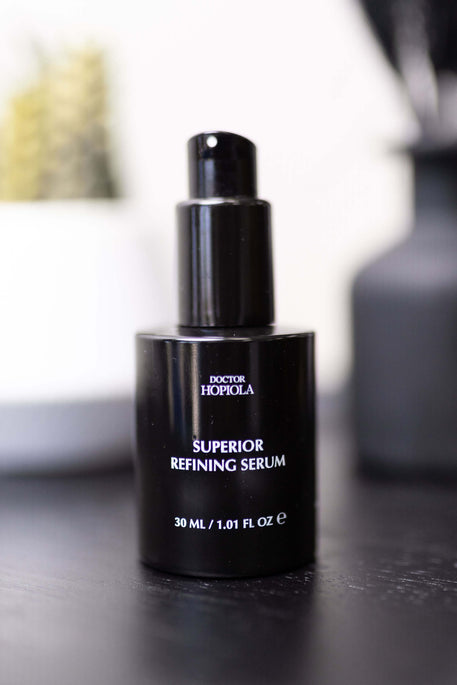
Bakuchiol is included in both the Brilliance Oil Concentrate and the Superior Refining Serum as one part of each complete formulation. The intention is to help refine the appearance of texture and uneven tone while supporting skin that feels comfortable and looks radiant.
The Brilliance Oil Concentrate is applied first. The Superior Refining Serum follows because it was specifically formulated to complete the two-step routine in that order.
These products are not the creams used in the comparative clinical trial. The results of that study should therefore not be interpreted as proof that every product containing bakuchiol will perform like retinol, or like the products studied.
That distinction does not diminish bakuchiol.
It allows the ingredient to be what the evidence supports: a promising, plant-derived option for people who want visible refinement without assuming that more irritation means more progress.
Consistency can be quiet and still be meaningful.
Individual results may vary.
Frequently Asked Questions
Is bakuchiol the same as retinol?
No. Retinol is a vitamin A derivative. Bakuchiol is a different, plant-derived compound. Research suggests that the two may influence some overlapping biological pathways and support some similar visible improvements, but bakuchiol is not a form of retinol.¹
Is bakuchiol gentler than retinol?
It appears to be better tolerated by many people. In one direct comparative study, participants using retinol reported more scaling and stinging than those using bakuchiol.² That does not mean bakuchiol is non-irritating for everyone.
Is bakuchiol as effective as retinol?
The available evidence is not strong enough to make that broad claim.
One small, 12-week trial found no statistically significant difference between the study groups in improvements in wrinkle surface area and hyperpigmentation.² Retinoids, however, have been evaluated far more extensively and over a much longer period.
Can I use bakuchiol every day?
Many finished bakuchiol products are intended for daily use. Follow the directions for your particular formula. If your skin is sensitive or reactive, begin gradually and increase only as your skin remains comfortable.
Can I use bakuchiol with vitamin C?
Bakuchiol is commonly included in routines with other cosmetic ingredients, including vitamin C. Whether the combination feels comfortable will depend on the complete formulas and your individual skin.
Introduce one new active product at a time if your skin reacts easily.
Can I use bakuchiol during pregnancy?
Bakuchiol is not a retinoid, but pregnancy-specific human safety data remain limited. Speak with your obstetric clinician before introducing it during pregnancy or breastfeeding.
How long does bakuchiol take to work?
The most frequently cited direct comparison evaluated visible changes over 12 weeks.² This is not a guaranteed timeline. Results depend on the finished formula, frequency of use, individual skin, and consistency.
References
-
Chaudhuri RK, Bojanowski K. Bakuchiol: a retinol-like functional compound revealed by gene expression profiling and clinically proven to have anti-aging effects. International Journal of Cosmetic Science. 2014;36(3):221–230. doi:10.1111/ics.12117.
-
Dhaliwal S, Rybak I, Ellis SR, et al. Prospective, randomized, double-blind assessment of topical bakuchiol and retinol for facial photoageing. British Journal of Dermatology. 2019;180(2):289–296. doi:10.1111/bjd.16918.
-
Puyana C, Chandan N, Tsoukas M. Applications of bakuchiol in dermatology: systematic review of the literature. Journal of Cosmetic Dermatology. 2022;21(12):6636–6643. doi:10.1111/jocd.15420.
-
Faulkner J, Uthayakumar AK, Atkins J. Babchi oil-induced phytophotodermatitis mimicking burn injury. JPRAS Open. 2021;27:23–26. doi:10.1016/j.jpra.2020.11.003.
Medical note: This guide is provided for general education and does not constitute medical advice. Cosmetic products are not intended to diagnose, treat, cure, or prevent disease. Individual responses vary. Consult a qualified clinician for persistent skin concerns, pregnancy or breastfeeding questions, or guidance involving prescription therapies.
Evidence reviewed July 2026.
Shop This Routine
The Dr. Hopiola two-step practice brings bakuchiol into a routine designed to be easy to use every day.
- Brilliance Oil Concentrate — Step one. Nourishing plant oils and antioxidants help support the skin barrier and leave the skin feeling soft and replenished.
- Superior Refining Serum — Step two. Bakuchiol and botanical extracts help improve the look of tone, texture, and overall radiance.
- The Radiance Set — Both steps, together. A simple two-step practice for healthier-looking, more radiant skin.


