





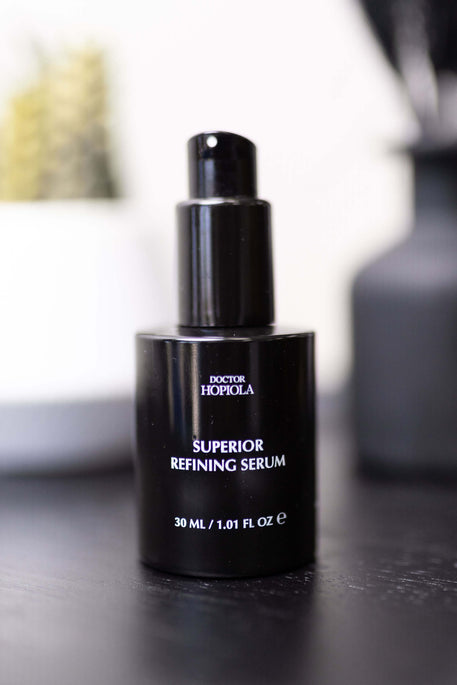
Dr. Hopiola Chronicles: Vol. 1. Efficacy vs. Tolerability: Rethinking the Retinoid Experience
The Scientific Case for Functional Analogues. Why We’re Reexamining “Retinol Intolerance”
Retinoids such as Tretinoin and Retinol are widely referenced in dermatologic research, particularly for their role in supporting the appearance of smoother, more refined skin. Yet from a clinical perspective, I often pay just as much attention to tolerability. Even the most researched ingredient offers limited real-world benefit if people discontinue use due to common concerns like dryness, visible redness, or discomfort, sometimes referred to as “retinization.”
For many people with full lifestyles, extended adjustment periods aren’t practical. This is where interest in functional analogues becomes scientifically meaningful.
The Mechanism: Bakuchiol & In Vitro Insights
Bakuchiol, a meroterpene phenol derived from Psoralea corylifolia, has gained attention not because it is “nature’s retinol,” but because its research pathway is distinct.
What the in vitro data shows:
Laboratory studies suggest that Bakuchiol may influence certain pathways associated with skin firmness and smoothness, including markers related to Collagen I, III, and IV.
Unlike retinoic acid, some studies indicate Bakuchiol does not activate the same pro-inflammatory markers in vitro.
This does not make it a retinoid or a replacement but rather, a well-studied botanical ingredient with its own profile and potential cosmetic benefits.
Lipid Support & The Stratum Corneum
To support the feel and appearance of a well-conditioned skin barrier, many formulators combine Bakuchiol with high-linoleic lipids.
Rosehip Seed Oil (Rosa rubiginosa) - Known for its Omega-6 content, which helps support the feel of supple, conditioned skin.
Sea Buckthorn (Hippophae rhamnoides) - A botanical source of palmitoleic acid (Omega-7), a naturally occurring skin lipid that contributes to a soft, nourished appearance.
These lipids do not “correct” barrier function in a medical sense but they can help improve the feel and cosmetic appearance of dryness or tightness.
Conclusion
The goal is not to replace traditional retinoids. Instead, functional botanical analogues like Bakuchiol paired with supportive lipids offer an option for individuals who prefer a cosmetic formula designed for a gentler, more comfortable experience.
This approach acknowledges that high performance and mindful formulation can coexist, especially for those seeking smoother, more radiant-looking skin without the heaviness of a complicated routine.
This article is part of The Dr. Hopiola Chronicles: a weekly look into the science behind intentional formulation.
Curious about the lipid-first methodology? You can explore it here.


