





How Long Does It Take to Repair a Damaged Skin Barrier?
By Dr. Hope Ijaola, Board-Certified Internist and Founder of Dr. Hopiola
When your skin suddenly begins to sting, flake, or feel tight, the natural question is: How long will this take to go away?
There is no single recovery timeline.
Mild irritation may begin to feel better within several days once the source is removed. More noticeable dryness, roughness, or sensitivity may take several weeks to settle. Recovery can take longer when the disruption has been building over time, when an underlying skin condition is present, or when the original irritant is still somewhere in the routine.
That last point is often the one people miss.
Skin cannot settle while it is still being asked to tolerate the thing that disrupted it.
How Long Does Skin-Barrier Recovery Usually Take?
In controlled research, experimentally disrupted skin can recover a substantial amount of barrier function within the first several days. But those studies commonly use methods such as tape stripping to create a defined, measurable disruption. They do not recreate every real-life cause of irritated skin (1).
At home, recovery depends on:
-
What caused the disruption
-
How long it had been occurring
-
Whether the exposure has stopped
-
Your age and underlying skin condition
-
The climate and humidity
-
The products you continue to use
A more useful way to think about recovery is by signs of progress rather than a fixed deadline.
The first several days: less discomfort
Stinging, burning, and post-cleansing tightness may begin to ease first.
This does not mean the barrier is fully recovered. It means the skin is becoming more comfortable after the source of irritation has been removed.
The next few weeks: steadier comfort
Flaking and roughness may begin to settle. Moisturizer may feel as though it lasts longer, and basic products may become more comfortable to apply.
Progress is not always perfectly linear. Weather, travel, cleansing habits, and accidental exposure to an irritating product can temporarily change how the skin feels.
Later recovery: tolerance becomes more consistent
The skin may eventually tolerate its simple routine without persistent stinging, redness, or tightness.
This is the point at which you may consider reintroducing other products, but one at a time and at a lower frequency than before.
The goal is not to reach a particular date. It is to reach a stable period of comfort.
Why Recovery Takes Longer for Some People
Two people can use the same product and have very different recovery experiences.
The severity and duration of the disruption
A single overzealous exfoliation session is different from using multiple irritating products for several months. Cumulative disruption may take longer to recognize and longer to settle.
Continued exposure
An exfoliating toner may be the obvious culprit, but irritation can also come from a cleanser, leave-on treatment, sunscreen, makeup product, fragranced hair product, or several individually tolerable products used together.
If the trigger remains in the routine, improvement may be limited.
Age
Research has found slower recovery after experimental barrier disruption in adults over 80 compared with adults ages 20 to 30 (2).
That does not mean recovery takes exactly twice as long at a particular age. It means age can influence how quickly the skin responds after disruption, making a measured approach especially important for mature skin.
An underlying skin condition
Eczema, contact dermatitis, rosacea, psoriasis, and infection can all cause symptoms that resemble a disrupted barrier.
If the skin is not improving with gentle care, or if symptoms are worsening, the problem may require diagnosis rather than another routine adjustment.
How Long Does It Take to Notice a Difference From a Barrier-Supporting Product?
A cosmetic product can make the skin feel softer or more comfortable before there is any measurable change in barrier function.
That distinction matters.
Humectants can increase surface hydration. Emollients can make rough skin feel smoother. Occlusive ingredients can reduce moisture loss. These are useful cosmetic effects, but they do not establish that the barrier has been fully “repaired.”
When evaluating a new, well-tolerated product, look for gradual changes such as:
-
Less tightness between applications
-
Greater comfort after cleansing
-
Less visible flaking
-
A smoother feel
-
More consistent hydration
Do not rely on a rigid one-, two-, or four-week promise. Product formulation, skin condition, environment, and consistent use all affect what you may notice and when.
If a product causes persistent burning, increasing redness, swelling, or worsening discomfort, stop using it. A barrier-supporting label does not guarantee that every formula will suit every skin.
How Is Skin-Barrier Recovery Measured in Research?
Two measurements often appear in cosmetic and dermatologic research: transepidermal water loss and corneometry.
They measure different things.
|
Measurement |
What it assesses |
What the result can suggest |
|
Transepidermal water loss (TEWL) |
The amount of water passing from the body through the skin and evaporating from its surface |
Higher readings may indicate increased water loss and impaired permeability-barrier function |
|
Corneometry |
Water content in the outermost skin layer |
Higher readings generally indicate greater surface hydration |
TEWL is commonly used to study permeability-barrier function. However, readings are sensitive to testing conditions, including temperature, humidity, body site, acclimatization, and the instrument used. Standardized guidance exists because these variables matter (3).
Corneometry assesses hydration closer to the skin’s surface. A humectant may improve corneometry readings relatively quickly by increasing surface hydration without proving that the underlying barrier structure has changed.
Both findings can be valuable. They are simply not interchangeable.
When a skincare claim refers to “measured improvement,” useful questions include:
-
What was measured?
-
Which instrument was used?
-
How many people were studied?
-
Was there a control or comparison?
-
How long was the product used?
-
Was the change statistically and clinically meaningful?
A percentage is only as informative as the test behind it.
How Do I Know If My Skin Barrier Has Recovered?
At home, you cannot confirm barrier recovery as precisely as a research laboratory can. You can, however, watch for practical signs that your skin has become more stable.
Those signs include:
-
Your gentle cleanser no longer leaves prolonged tightness
-
Your basic moisturizer applies without burning
-
Hydration feels more consistent between applications
-
Flaking and roughness have decreased
-
Redness has returned to your usual baseline
-
Your skin remains comfortable for several consecutive days
Comfort is meaningful, but it is not a reason to restart every active product at once.
Recently settled skin may become irritated again if several exfoliants or retinoids are reintroduced together. Give the skin a stable period, then add one product at a time.
If burning or redness returns, pause the product rather than trying to push through.
Why Is My Skin Barrier Not Getting Better?
If your skin is not improving, review the full routine, not only the product you suspect caused the problem.
An irritating product may still be present
Check cleansers, toners, serums, spot treatments, sunscreens, makeup primers, masks, and products used near the hairline.
Ingredients such as glycolic acid and salicylic acid may appear in products that are not prominently marketed as exfoliants.
You may be combining too many active products
Look at your routine across the entire week.
A retinoid twice weekly, an acid toner on alternate nights, an exfoliating cleanser, and a weekend peel may feel separate. Your skin experiences the total exposure.
You may have reintroduced products too quickly
Feeling better for one or two days is not the same as reaching stable comfort.
Give your skin time before testing another active product, and reintroduce only one at a time.
The problem may not be simple barrier disruption
Persistent redness, burning, itching, scaling, or recurrent rashes can have causes that a skincare routine alone will not resolve.
If several weeks of gentle care produce no meaningful improvement, or symptoms are worsening, seek medical evaluation instead of continuing to experiment.
When Should You See a Physician?
Seek medical care sooner if you develop:
-
Oozing, crusting, or open areas
-
Blistering or significant swelling
-
A painful, spreading, or clearly defined rash
-
Skin that feels unusually hot or tender
-
Symptoms around the eyes
-
Signs of infection
-
A reaction that affects breathing or causes facial or throat swelling
You should also arrange an evaluation if symptoms persist despite a simplified, gentle routine.
Barrier disruption is a physiological state. Eczema, allergic contact dermatitis, rosacea, psoriasis, and infection are medical conditions. They can look similar, but they are not managed in the same way.
Frequently Asked Questions
Can a damaged skin barrier repair itself without products?
The skin has its own recovery processes. Removing the source of disruption is often the most important first step.
A simple, well-tolerated routine can support comfort, hydration, and protection while that recovery takes place. More products do not necessarily mean faster progress.
How long should I wait before reintroducing retinol?
There is no universal four- or six-week rule.
Wait until your skin has been consistently comfortable, without persistent burning, redness, or flaking. Then consider restarting at a lower frequency than before.
For many people, once or twice weekly is a more cautious starting point, but the right schedule depends on the product, concentration, and individual skin. If irritation returns, stop and seek professional guidance.
Does drinking more water repair the skin barrier?
Adequate hydration supports general health, but drinking additional water is not a substitute for addressing topical irritation or an underlying skin condition.
The skin barrier depends on the structure and composition of the stratum corneum, not simply on how many glasses of water you drink.
Can I use vitamin C while my skin barrier is recovering?
If your vitamin C product stings or appears to worsen redness, pause it.
Some vitamin C formulations, particularly those containing acidic forms at a low pH, may feel uncomfortable on reactive skin. Once your skin has settled, you can consider reintroducing the product gradually.
How do I know if a product is making my skin worse?
Watch for burning that persists, redness that increases, new swelling, worsening tightness, or discomfort that builds with repeated use.
Brief sensation does not always mean injury, but you do not need to tolerate escalating discomfort for a product to “work.”
Is it normal for skin to get worse before it gets better?
Barrier recovery should generally move toward greater comfort.
Temporary variation can occur, but steadily increasing burning, redness, flaking, or pain is not a sign that recovery is working. It is a reason to reassess the routine or seek medical advice.
Not Sure Where Your Skin Stands?
It can be difficult to tell whether your skin is still actively irritated, beginning to settle, or ready for a more complete routine.
Our complimentary Skin Barrier Assessment walks you through the same kinds of questions I consider when evaluating a routine and helps you understand what your skin may need next.
Take the Skin Barrier Assessment
When You Are Ready for a Simpler Routine
The first priority for skin that is actively burning, swollen, oozing, or painful is appropriate medical care, not a new cosmetic product.
Once your skin feels comfortable and you are ready to build a more intentional routine, simplicity can make consistency easier.
I formulated the Dr. Hopiola Radiance Set as two complementary steps for moisture, comfort, and healthy-looking radiance.
Brilliance Oil Concentrate - Step One
A waterless blend of botanical oils and antioxidant-rich extracts that helps replenish moisture and leave dry, depleted skin feeling supple.
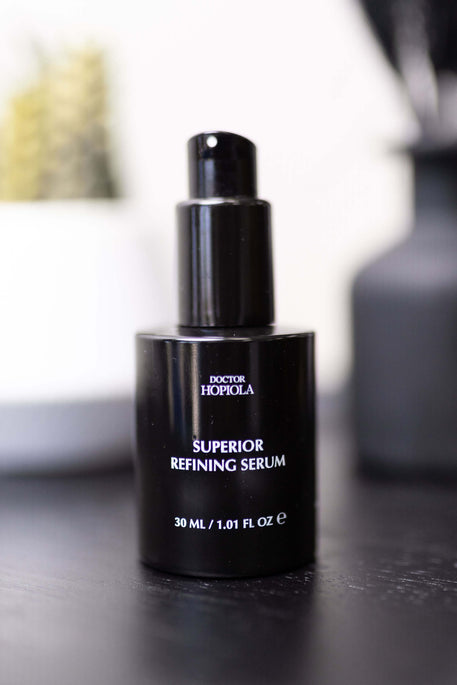
Superior Refining Serum - Step Two
A hydrating botanical serum formulated to help improve the appearance of tone and texture while supporting a soft, comfortable finish.
The Radiance Set - Both steps, together
Oil first. Then serum. Two complementary formulas, designed to work together.
Individual results may vary.
Dr. Hopiola products are cosmetic formulations and are not intended to diagnose, treat, cure, or prevent any disease.
This content is for educational purposes only and does not constitute medical advice.
References
-
Elias PM. Stratum corneum defensive functions: an integrated view. Journal of Investigative Dermatology.2005;125(2):183–200. doi:10.1111/j.0022-202X.2005.23668.x
-
Ghadially R, Brown BE, Sequeira-Martin SM, Feingold KR, Elias PM. The aged epidermal permeability barrier: structural, functional, and lipid biochemical abnormalities in humans and a senescent murine model. Journal of Clinical Investigation. 1995;95(5):2281–2290. doi:10.1172/JCI117919
-
Rogiers V; EEMCO Group. EEMCO guidance for the assessment of transepidermal water loss in cosmetic sciences. Skin Pharmacology and Applied Skin Physiology. 2001;14(2):117–128. PubMed


