





Why Irritation Can Leave Dark Marks
A Physician’s Guide to Post-Inflammatory Hyperpigmentation in Deeper Skin Tones
By Dr. Hope Ijaola, Board-Certified Internist and Founder of Dr. Hopiola
The mark can outlast the thing that caused it.
A breakout heals. An ingrown hair settles. A patch of irritation disappears. But a darker area remains where the inflammation was, and it may stay visible for weeks or months.
For people with deeper skin tones, these marks can be particularly noticeable and slow to fade.
The instinct is often to reach for something stronger to remove them.
But there is another question worth asking:
What keeps creating them?
Because when skin is prone to post-inflammatory hyperpigmentation, reducing unnecessary irritation can be just as important as treating the marks that are already there.
What Is Post-Inflammatory Hyperpigmentation?
Post-inflammatory hyperpigmentation, or PIH, is a change in skin color that develops after inflammation or injury.
The process begins with inflammation. Inflammatory signals can stimulate melanocytes, the cells that produce pigment, to increase melanin production. That excess pigment may remain closer to the surface of the skin or settle more deeply after injury.¹
This helps explain why some marks fade more readily than others. Epidermal PIH often appears brown and may gradually fade. Deeper pigment may look gray-brown or blue-gray and can take longer to resolve.¹
Many everyday skin concerns can trigger PIH, including acne, eczema, ingrown hairs, shaving irritation, insect bites, minor injuries, cosmetic procedures, allergic reactions, and skincare that the skin simply did not tolerate well.¹˒²
The inflammation leaves.
The pigment remembers.
Why PIH Is More Noticeable in Deeper Skin Tones
This is not simply a matter of deeper skin being “more sensitive.”
It is about pigment biology.
People across skin tones have broadly similar numbers of melanocytes. What differs is how melanin is produced, packaged, and distributed. In deeper skin tones, these differences can make pigment changes following inflammation more visible and more persistent.¹˒²
Inflammation can also look different across skin tones. It may not always appear bright red. It can look brown, purple, gray, or simply darker than the surrounding skin.
By the time the irritation itself has settled, the discoloration may be the most visible evidence that it happened.
The Part Many Dark-Mark Routines Miss
If your skin develops PIH easily, irritation is not just an uncomfortable side effect.
It can become part of the problem.
Repeated burning, stinging, peeling, or persistent tightness can be signs that your skin is being pushed beyond what it comfortably tolerates. And in skin that pigments readily, repeated inflammation or injury can contribute to further discoloration.¹˒²
That creates a frustrating cycle:
You see a dark mark.
You treat it more aggressively.
Your skin becomes irritated.
The irritation leaves another mark.
This is why a routine does not have to feel harsh to be effective.
For pigment-prone skin, tolerability is part of the strategy.
Sources of Irritation You May Not Count
Sometimes one product is clearly the problem.
More often, it is the pattern of use.
Too many exfoliants. An acid toner, peeling pads, a scrub, and a resurfacing serum may each seem reasonable on their own. Together, they can become more than your skin comfortably tolerates.
Starting active ingredients too quickly. Retinoids and exfoliating acids often require a thoughtful introduction. More frequent use does not automatically mean faster results.
Overcleansing. If your skin routinely feels tight, dry, or uncomfortable after washing, your cleanser, or the way you are using it, may be too aggressive for your skin.
Pushing through irritation. Persistent burning, peeling, or stinging is not proof that a product is working.
Hair removal. Shaving, waxing, threading, and friction can all provoke inflammation, particularly when the same area is treated repeatedly before it has recovered.
Picking. I say this without judgment because nearly everyone does it. But picking extends the injury and inflammation that can leave pigment behind.
A product your skin simply does not tolerate. Botanical, natural, fragranced, and clinical-sounding products can all cause irritation or allergy. Natural origin is not a guarantee of gentleness.
Signs Your Routine May Be Working Against Your Skin
Pay attention when products routinely sting, cleansing leaves your skin tight, flaking becomes persistent, or new dark marks seem to appear faster than older ones fade.
These signs do not diagnose inflammation or a damaged skin barrier on their own.
But they may be telling you that your routine is asking too much of your skin.
When that happens, the most useful next step is often not another active ingredient.
It is less.
Pause what is irritating. Simplify the routine. Let the skin become comfortable again. Then reintroduce products one at a time so you can understand what your skin actually tolerates.
Why Tolerability Matters
“Gentle” is an easy word to put on a skincare label.
What matters more is whether the finished formula, and the way you use it, is comfortable enough for your skin to use consistently.
Plant oils, for example, can serve as useful emollients in cosmetic formulations, but they are not interchangeable and they are not automatically gentle. Their effects vary according to their composition and the finished formulation.³
The same principle applies to active ingredients.
Bakuchiol is one ingredient I chose in part because tolerability matters to me. In a small randomized comparison with retinol, both groups experienced improvements in measured hyperpigmentation and wrinkle outcomes, while participants using retinol reported more scaling and stinging.⁴
That does not establish bakuchiol as a treatment for PIH, nor does it prove that every bakuchiol formulation will perform the same way. The study examined facial photoaging, not PIH specifically.
What it does reinforce is something I believe matters in skincare:
An ingredient only has the opportunity to work when your skin can comfortably live with it.
Sun Protection Is Part of PIH Care
Preventing irritation is only part of the picture.
Ultraviolet radiation can worsen PIH, and visible light can also contribute to persistent pigmentation, particularly in deeper skin tones.²˒⁵
That makes daily photoprotection an important part of any routine focused on dark marks.
Use a broad-spectrum sunscreen consistently. For people particularly prone to facial hyperpigmentation, a tinted sunscreen formulated with iron oxides may provide additional protection against visible light.⁵˒⁶
You do not need an elaborate routine.
But you do need consistent protection.
When to See a Professional
Not every dark mark is PIH.
Melasma, medication-related pigmentation, certain infections, and other skin conditions can resemble it and may require a different approach.
Consider seeing a dermatologist or another qualified clinician if pigmentation appears without an obvious preceding trigger, spreads rapidly, or is accompanied by persistent itching, pain, scaling, or rash.
Persistent acne, recurrent ingrown hairs, eczema, or allergic reactions also deserve attention.
Sometimes the best way to prevent another dark mark is to treat what keeps causing the inflammation.
A Dr. Hopiola Perspective
When I formulate skincare, I am not interested in creating a routine your skin has to endure in order to see a result.
I am interested in what can be used consistently, intentionally, and comfortably.
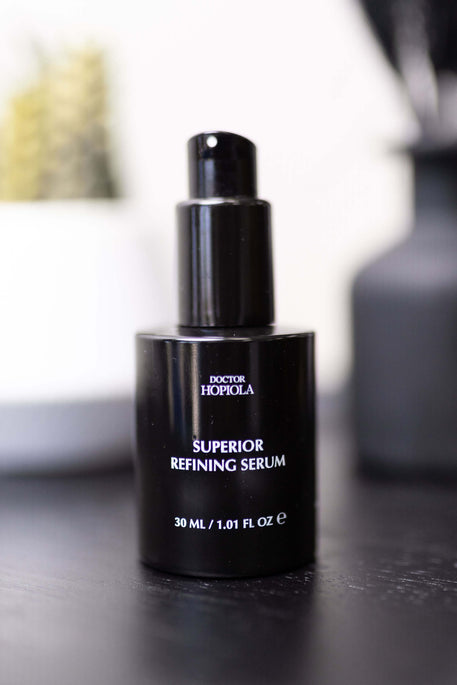
That thinking shaped the Brilliance Oil Concentrate and Superior Refining Serum. Together, they make up the Radiance Set: two steps designed to work as a considered whole rather than an escalating series of actives.
They are not treatments for post-inflammatory hyperpigmentation.
They reflect something simpler:
Good skincare should not have to provoke your skin to make progress.
Frequently Asked Questions
How long does post-inflammatory hyperpigmentation take to fade?
There is no universal timeline. Superficial PIH may gradually improve over months, while pigment that sits deeper in the skin can persist considerably longer. Skin tone, the depth of pigment, sun exposure, ongoing inflammation, and treatment all influence how quickly a mark fades.¹
Why do acne marks last longer on deeper skin tones?
Inflammation can trigger increased pigment production. Differences in the production, packaging, and distribution of melanin can make that response more visible and persistent in deeper skin tones.¹˒²
Can irritation make hyperpigmentation worse?
Yes. Irritation and inflammation can trigger or worsen PIH in people who are prone to it. This is why treatment-related irritation deserves attention rather than automatically being accepted as part of the process.¹˒²
Are dark acne marks the same as acne scars?
No.
A flat brown, gray, or darker area left after acne is often post-inflammatory hyperpigmentation, a change in pigment.
A true acne scar involves a change in the structure or texture of the skin, such as an indentation or raised area.
The two can occur together, but they are not the same thing.
A Final Thought
When a dark mark appears, it is natural to focus on how to make it disappear.
But sometimes the more useful question comes first:
What keeps asking my skin to make another one?
Less irritation will not solve every case of hyperpigmentation.
But for skin that remembers inflammation in pigment, a quieter routine can be a meaningful place to begin.
Consistency can be gentle and still create progress.
Dr. Hopiola products are cosmetic formulations and are not intended to diagnose, treat, cure, or prevent disease.
This article is provided for educational purposes only and does not constitute medical advice. Individual results may vary.
References
-
Davis EC, Callender VD. Postinflammatory hyperpigmentation: a review of the epidemiology, clinical features, and treatment options in skin of color. J Clin Aesthet Dermatol. 2010;3(7):20–31.
-
Mar K, Khalid B, Maazi M, Ahmed R, Wang OJ, Khosravi-Hafshejani T. Treatment of post-inflammatory hyperpigmentation in skin of colour: a systematic review. J Cutan Med Surg. 2024;28(5):473–480. doi:10.1177/12034754241265716.
-
Lin TK, Zhong L, Santiago JL. Anti-inflammatory and skin barrier repair effects of topical application of some plant oils. Int J Mol Sci. 2018;19(1):70. doi:10.3390/ijms19010070.
-
Dhaliwal S, Rybak I, Ellis SR, et al. Prospective, randomized, double-blind assessment of topical bakuchiol and retinol for facial photoageing. Br J Dermatol. 2019;180(2):289–296. doi:10.1111/bjd.16918.
-
Fatima S, Braunberger T, Mohammad TF, Kohli I, Hamzavi IH. The role of sunscreen in melasma and postinflammatory hyperpigmentation. Indian J Dermatol. 2020;65(1):5–10.
-
Lyons AB, Trullas C, Kohli I, Hamzavi IH, Lim HW. Photoprotection beyond ultraviolet radiation: a review of tinted sunscreens. J Am Acad Dermatol. 2021;84(5):1393–1397.


