





Why Skin Changes in Fall Season
Every fall, the same things begin to happen.
Skin feels tighter after cleansing. Flaking appears where there was none in July. Makeup sits differently on the same face. A routine that felt perfectly comfortable all summer suddenly feels like too much.
The products may not have changed.
The environment did.
Cold temperatures and lower humidity can affect the skin barrier and reduce water content in the outer layers of the skin. Indoor heating can lower relative humidity further. Together, those changes help explain why skin often feels drier, rougher, or more reactive as fall turns into winter.¹
The answer is usually not an entirely new skincare routine.
It is calibration.
What Cold Weather Does to Your Skin
Your skin barrier is the outermost protective layer of your skin. One of its jobs is to help keep water in and irritants out.
Cold, dry conditions can make that job more difficult.
Research has found seasonal changes in the lipids that help form this barrier, while broader reviews of environmental exposure show that low temperature and low humidity can impair barrier function and make skin more vulnerable to irritation.¹˒²
You may notice the effects as tightness, roughness, flaking, itching, or products suddenly feeling less comfortable than they did a few months earlier.
That does not necessarily mean your skin has fundamentally changed.
Sometimes the environment simply changes what your skin needs from you.
What Dry Winter Skin Actually Needs
Most winter skincare advice becomes complicated very quickly.
The basic idea is simpler.
Dry skin benefits from water and lipids, and from reducing how easily water escapes.
Skincare formulations accomplish this in different ways.
Humectants help increase water in the outer layers of the skin. Glycerin and hyaluronic acid are familiar examples.
Emollients soften and smooth the skin surface. Many botanical oils work primarily this way.
Occlusives form a barrier that reduces water evaporation. Petrolatum is one of the most effective examples.
Many moisturizers combine these functions in a single formula. Facial oils are different: they contain no water and primarily provide emollient lipids, with their other properties depending on the oils and formulation.
That distinction matters when deciding what your skin actually needs.
Facial Oil vs. Moisturizer: Do You Need Both?
Not necessarily.
A moisturizer and a facial oil are not interchangeable, but that does not mean everyone needs both.
Most moisturizers are emulsions that contain water alongside humectants, emollients, and sometimes occlusive ingredients.
Facial oils are anhydrous. They contain no water and primarily contribute lipids that soften and condition the skin.
If your skin remains comfortable throughout winter with your usual moisturizer, there is no reason to add an oil simply because the season changed.
If your skin begins to feel rougher, tighter, or less comfortable, adding an oil may provide useful emollient support.
The formula matters, too. Plant oils differ considerably in fatty-acid composition and in how they behave on skin.³ An oil that works beautifully for one person may not be the right one for another.
More is not the goal. Comfortable skin is.
Can Oily Skin Use a Facial Oil in Winter?
Yes, but oily skin does not automatically need one.
Oil and water are different components of the skin. A person can have significant sebum production and still experience tightness, roughness, or other signs of insufficient hydration.
That can become more noticeable in winter.
If you have oily or combination skin and want to try a facial oil, introduce a small amount gradually and pay attention to how your own skin responds.
I would not make the decision based solely on the “comedogenic ratings” widely circulated online. Many of those numbers trace back to older testing methods, including animal models, that do not reliably predict how a finished cosmetic formula will behave on an individual person's face.
Your skin is more useful than a chart.
Why Active Ingredients Can Feel Different in Winter
This is another pattern people notice.
A retinoid or exfoliant that felt comfortable all summer suddenly causes flaking, burning, or tightness once the weather becomes cold and dry.
The product did not necessarily become too strong.
Your skin's tolerance may have changed.
When that happens, I would not automatically add more products to compensate. First look at the frequency of the active, how aggressively you are cleansing, and everything else you are layering around it.
If a retinoid or exfoliant begins causing persistent irritation, reduce the frequency or pause it while your skin recovers. Once your skin feels comfortable again, it can often be reintroduced more gradually.
You do not earn better results by making your skin endure more.
What About Bakuchiol?
For people who repeatedly struggle with retinoid irritation, bakuchiol is another ingredient worth knowing.
In a small, 12-week randomized comparison, 44 participants used either 0.5% bakuchiol twice daily or 0.5% retinol once daily. Both groups experienced significant improvement in measured wrinkle surface area and hyperpigmentation, while participants using retinol reported more scaling and stinging.⁴
That does not make bakuchiol the same as retinol, and retinoids have a much larger body of evidence behind them.
It does make tolerability part of an interesting conversation, particularly when dry winter conditions already make your skin less comfortable.
I explore the evidence and its limitations more fully in our Physician’s Guide to Bakuchiol.
A separate four-week study evaluated a bakuchiol-containing cleanser and moisturizer in 60 women with self-reported sensitive skin and mild-to-moderate photodamage. The formulation was well tolerated, but because it evaluated a multi-ingredient regimen rather than bakuchiol alone, I would not use it as evidence for bakuchiol by itself.⁵
Five Changes to Make Before Winter
You probably do not need to replace your entire routine.
Start here.
1. Turn down the water temperature.
Long, hot showers and washing can make already-dry skin feel worse. Warm water is enough.
2. Pay attention to your cleanser.
If your skin routinely feels tight or uncomfortable after washing, your cleanser, or the way you are using it, may be too aggressive for the season.
3. Moisturize soon after cleansing.
Applying moisturizer while the skin is still slightly damp can help support water retention. You do not need to race a stopwatch. Just do not wait until your skin already feels dry and tight.
4. Adjust active ingredients when your skin asks you to.
Persistent burning, peeling, or stinging is not a requirement for progress. Reduce the frequency or pause the offending product, allow your skin to become comfortable, and then reassess.
5. Consider your environment.
If indoor air becomes very dry once the heat comes on, a humidifier may make the environment more comfortable for your skin.
Small adjustments are often enough.
Winter Skincare Is Calibration, Not Replacement
This is the part I want you to remember.
The routine that serves your skin in July may still serve it in January.
You may simply need more emollient support. A gentler cleanser. Less frequent exfoliation. A little more patience with active ingredients.
Skincare should respond to the skin in front of you, not to a calendar telling you it is time to buy an entirely new routine.
Seasonal skincare is usually calibration, not replacement.
Why the Dr. Hopiola Routine Has Two Steps
This seasonal balance is also part of how I think about the Radiance Set.
Brilliance Oil Concentrate is our anhydrous oil step. It brings together botanical oils and oil-soluble ingredients in a formula designed to soften and condition the skin.
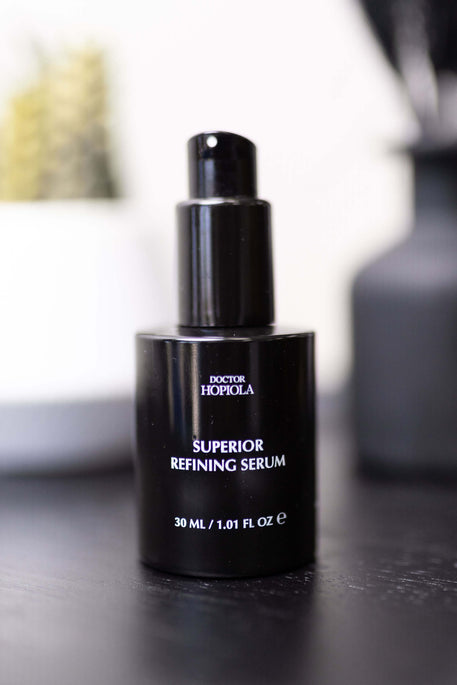
Superior Refining Serum is a water-based emulsion containing ingredients including aloe leaf juice, glycerin, propanediol, botanical oils, and squalane.
And the order is intentional.
Brilliance Oil Concentrate goes on first. Superior Refining Serum follows because I formulated the serum specifically to settle over the oil and complete the routine.
That runs counter to the generic advice you may have heard about always applying water-based products before oils.
Formulations are not generic.
Follow the directions for the products you are actually using.
For me, the point of two steps was never to make skincare more complicated. It was to create two considered formulas that work together without turning a daily routine into a project.
Two steps. By design.
Frequently Asked Questions
Why does my skin get dry when the weather changes?
Lower temperature and humidity can affect the skin barrier and reduce water content in the outer skin layers. Indoor heating can lower relative humidity further, which is why skin often begins to feel tighter or rougher as fall becomes winter.¹
Should I use facial oil in winter?
Only if your skin benefits from one. Facial oils primarily provide emollient lipids; they do not replace the water and humectant components of a moisturizer. If your existing routine keeps your skin comfortable, you do not need to add another step.
Can oily skin become dehydrated in winter?
Yes. Sebum and skin hydration are not the same thing. Oily or combination skin can still feel tight, rough, or uncomfortable when environmental conditions become drier.
Should I stop retinol during winter?
Not automatically. If your retinoid remains comfortable, there is no seasonal rule requiring you to stop. If you develop persistent dryness, burning, or peeling, reducing frequency or temporarily pausing it while your skin recovers may be appropriate.
A Final Thought
Your skin does not need the same thing every day of the year.
That does not mean every season requires another shelf of products.
Pay attention when your skin becomes tighter. When cleansing no longer feels comfortable. When an active you tolerated beautifully begins to feel like too much.
Then adjust.
A little more support. A little less intensity.
Sometimes that is all the season is asking for.
Dr. Hopiola products are cosmetic formulations and are not intended to diagnose, treat, cure, or prevent disease.
This article is provided for educational purposes only and does not constitute medical advice. Individual results may vary.
References
-
Engebretsen KA, Johansen JD, Kezic S, Linneberg A, Thyssen JP. The effect of environmental humidity and temperature on skin barrier function and dermatitis. J Eur Acad Dermatol Venereol. 2016;30(2):223–249. doi:10.1111/jdv.13301.
-
Rogers J, Harding C, Mayo A, Banks J, Rawlings A. Stratum corneum lipids: the effect of ageing and the seasons. Arch Dermatol Res. 1996;288(12):765–770. doi:10.1007/BF02505294.
-
Lin TK, Zhong L, Santiago JL. Anti-inflammatory and skin barrier repair effects of topical application of some plant oils. Int J Mol Sci. 2018;19(1):70. doi:10.3390/ijms19010070.
-
Dhaliwal S, Rybak I, Ellis SR, et al. Prospective, randomized, double-blind assessment of topical bakuchiol and retinol for facial photoageing. Br J Dermatol. 2019;180(2):289–296. doi:10.1111/bjd.16918.
-
Draelos ZD, Gunt H, Zeichner J, Levy S. Clinical evaluation of a nature-based bakuchiol anti-aging moisturizer for sensitive skin. J Drugs Dermatol. 2020;19(12):1181–1183. doi:10.36849/JDD.2020.5522.


